Latest Update:
Homeflow Launches AI-Powered Live Chat for Agents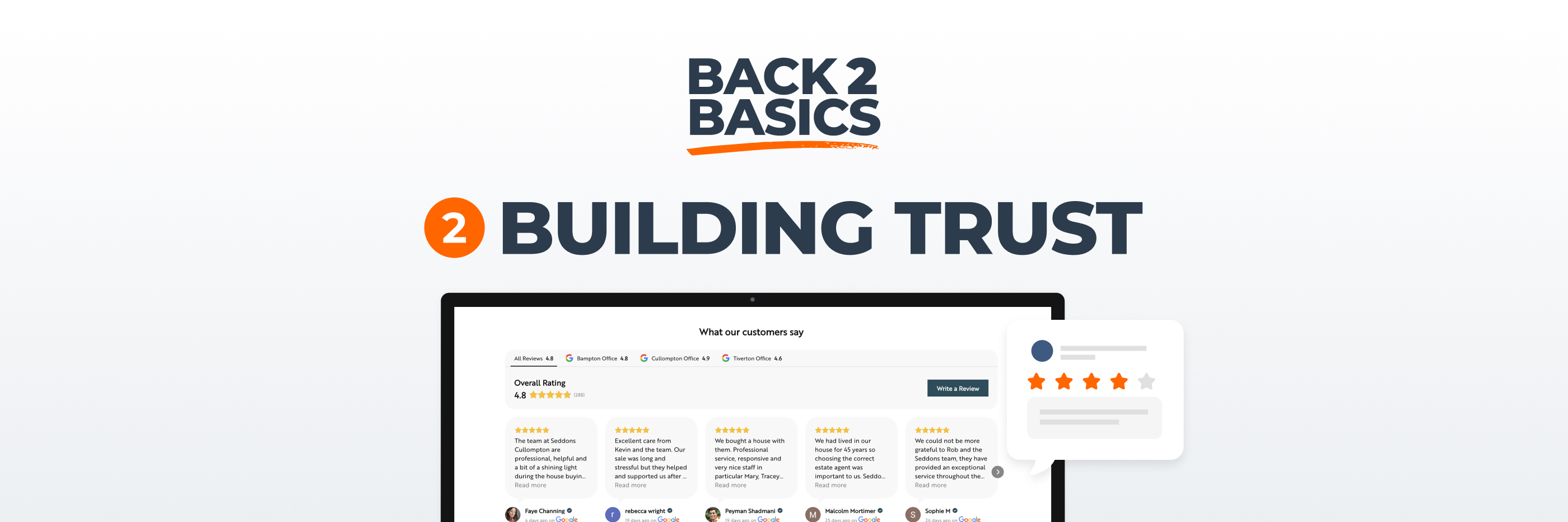
This is the second in our "Back to Basics" series, looking beyond the frenzied (and justified) excitement around AI and technology developments, and reminding of some of the crucial fundamentals for your estate agency website.
In the first article in this Back to basics series, we looked at something practical and often overlooked: making it easy to contact your agency. That’s the starting point, because if people can’t reach you quickly, trust never really gets a chance to develop.
But contact details alone aren’t enough.
When someone is considering selling their home, they aren’t just asking how to call you, they’re asking whether they should. That’s a very different question, and it’s one your website needs to answer convincingly.
At a time when there’s so much focus on automation and AI generated content, it’s worth remembering that property transactions remain deeply human decisions. People want to feel confident in the firm they choose; they want reassurance that you are established, competent and genuinely local; and they want that reassurance before they ever pick up the phone.
Your website plays a central role in shaping that impression.
Behind the browsing, the searching and the clicking, there’s a single underlying question sitting in the background.
Why should I choose you?
Many estate agency websites respond to that question with a list of familiar phrases. Trusted. Experienced. Local experts. Friendly service. While all of those qualities may be true, they are rarely persuasive on their own because every other agent in your town is saying something similar.
If you have a “Why sell with us” page, it should go beyond generic statements and explain, in concrete terms, what makes your approach different. That might include how you structure your marketing, how you qualify buyers, how your team is organised, or how you support clients through difficult chains. The key is specificity, as the more tangible your claims, the more believable they become.
A strong differentiation page doesn’t need to be dramatic or over designed, it just needs to feel real.
Social proof now carries enormous weight in almost every purchasing decision, and estate agency is no exception.
Most prospective vendors will look at your reviews, whether you draw attention to them or not. In many cases they will check Google independently, regardless of what you display on your website. That’s simply how people validate businesses today.
Because of that, it makes sense to embrace reviews rather than treat them as an afterthought.
If you have strong Google reviews, make them visible. Display selected four and five star reviews on your homepage or branch pages in a way that feels natural rather than forced. Link clearly to your full review profile so that visitors can explore further if they wish. Transparency builds confidence.
It’s also important to make it easy for satisfied clients to leave a review. A simple link, shared at the right time in the transaction, can steadily build a review base that becomes one of your most valuable marketing assets.
Over time, consistent positive feedback does far more to establish credibility than any slogan ever could.
Another subtle but powerful trust signal is evidence that your agency has a presence beyond its own domain.
Clear links to your social media profiles, typically in the footer and sometimes in the header, reassure visitors that you operate in the open. When those profiles are active, branded consistently and updated with meaningful content, they reinforce the sense that your business is established and engaged in the local community.
This doesn’t mean posting every property on every platform. In fact, that approach can feel repetitive and self focused, and adds very little other than noise. Sharing local insights, community involvement, market commentary and behind the scenes moments often creates a more rounded impression.
The key point is that your social presence should look alive and intentional. An abandoned page with outdated branding can undermine credibility faster than having no link at all.
Trust is often built in small, almost invisible ways.
When your branding is consistent across your website and social channels, when your tone of voice feels measured rather than exaggerated, and when your claims are supported by evidence rather than vague promises, visitors relax. They may not articulate why they feel comfortable, but the impression accumulates.
Conversely, inconsistencies create unease. If your website feels polished but your social pages look neglected, or if your marketing claims seem inflated compared with your reviews, doubts begin to form.
None of these elements works in isolation, but together, they shape perception.
In many markets, especially outside major cities, local presence remains a decisive factor.
If your agency has long standing roots in the area, make that clear. If your team members are recognisable faces in the community, highlight that connection. If you support local events or charities, reference it naturally rather than as a boast.
These signals anchor your brand in something tangible, and they demonstrate that you are not just a digital interface but a business with real relationships and real accountability.
The way you write and present information on your website contributes directly to how trustworthy you appear.
Overblown claims, exaggerated promises or overly sales driven language can create scepticism, particularly among experienced vendors. A calm, professional tone that explains rather than persuades tends to inspire more confidence.
It’s worth reviewing your core pages with that in mind. Are you explaining how you work in a way that feels measured and transparent? Or are you relying on sweeping statements that could apply to almost any agency?
Credibility grows when communication feels considered rather than performative.
If you want to assess how your website performs on trust and credibility, try stepping into the shoes of a cautious vendor.
Imagine you are about to invite three agents to value your home, and visit each website in turn. Within five minutes, which one feels most reassuring? Which one feels established and open? Which one feels vague or overly polished?
Often the differences are subtle. Clear evidence, visible reviews, thoughtful differentiation and consistent branding tend to stand out more than dramatic design.
Trust is earned through clarity, proof and steadiness, and in a market where tools are becoming more sophisticated and competition remains intense, credibility remains one of the most durable advantages you can build. When your website reflects who you are, supports your claims with evidence and presents your business with quiet confidence, it does far more than look professional, it gives people a reason to choose you.